


If you’re weighing whether to sell your KCK or KCMO house, the state line changes some of the math, but it does not make one side impossible.
Your address can affect property-tax questions, buyer expectations, and how the paperwork is handled. It does not change the basic fact that you can sell and move on.
This guide walks through how selling a house in Kansas City Kansas vs Missouri: taxes, typical buyers, timing, repairs, paperwork, and what changes if a cash offer fits your situation better.
The state line matters because it changes your county, your tax setup, and often the kind of buyers looking in your area, but it does not stop you from getting the house sold.
The Kansas City metropolitan area spans two states and includes cities and suburbs on both sides of the state line, which can affect the local offices, tax bills, school-district conversations, and closing paperwork involved in your sale.
On the Kansas side, especially in newer suburb-style pockets, buyers tend to care closely about schools, updates, and move-in-ready condition. On the Missouri side, you may see a wider mix of older city neighborhoods, classic bungalows, and suburban areas, meaning a blend of first-time buyers, families, downsizers, and investors depending on the block.
Even two similar three-bedroom houses can end up with a different net because:
The state line changes the math, not your ability to sell.
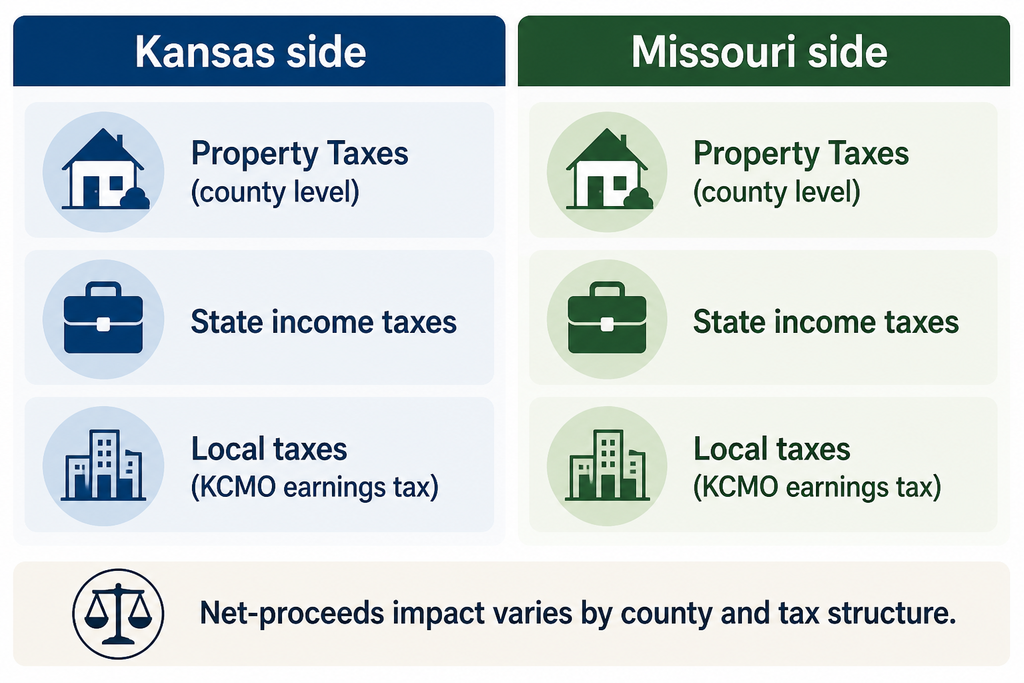
Your side of the state line does not automatically ruin your sale, but different tax setups on the Kansas and Missouri sides can change how buyers do the math and what you walk away with. There are three tax buckets in the background:
| Tax Bucket | What It Means for a Seller |
| Property taxes (county and local) | Shaped at the county level; doesn’t change whether you can sell, but affects a buyer’s monthly payment and budget |
| State income taxes | Kansas and Missouri each have their own systems; mostly a filing-time question for a tax professional |
| Local tax considerations | Part of the broader affordability picture rather than a separate closing-table problem |
Higher ongoing ownership costs can cap what buyers are willing to pay for the same monthly budget. A buyer trying to keep the total monthly cost steady may not value two similar houses the same if one carries a heavier tax burden. That is an illustration, not tax advice; check your county website or a tax professional for your own situation.
Your side of the line does not automatically wreck your sale. It just shapes how buyers compare your house to the one across town.
Who is buying on each side is less about the state name and more about the specific neighborhood, but patterns show up:
| Factors | Kansas side | Missouri side |
| Common buyer focus | Newer subdivisions or well-kept older neighborhoods | A wider mix: first-time buyers, downsizers, investors, and families |
| Condition expectations | Move-in ready, with neutral paint, updated kitchens and baths, solid major systems | Classic older homes with character are tolerated; some buyers actively seek fixer-uppers |
| Who’s active | Traditional retail buyers ready to pay more for a finished home | First-time buyers, downsizers, city-neighborhood investors, and families wanting something clean but not brand new |
An older three-bedroom, one-bath house with dated finishes may still draw investors or budget-conscious buyers, even if some families chasing newer homes pass. A similar floor plan in a newer Kansas-side subdivision may sit longer if it is not updated, because retail buyers there may expect a certain finish level from the start.
The critical question is not whether Kansas buyers expect more than Missouri buyers. It is what your neighborhood’s buyer pool expects, and what it will cost you to meet that expectation. You can chase a retail buyer with repairs, or compare that path against an investor or cash-sale path at a lower sticker price to see which leaves you with the better net.
Kansas and Missouri each have their own real estate laws, standard contracts, and disclosure forms, so the paperwork does not look identical. The big-picture job is the same on both sides: be honest about known problems and work with professionals who handle the details every day.
Many sellers worry that one missed box or wrong form will create trouble. That is why agents, title companies, attorneys when needed, and experienced local buyers exist: to help keep the right state-specific forms and closing steps on track.
There is no blanket rule where one side of the state line is always faster. Speed mostly depends on your price range, neighborhood, condition, and how you choose to sell. As of 2024, HUD’s Kansas City MO-KS Comprehensive Housing Market Analysis provides a metro-wide look at housing conditions, but a market snapshot doesn’t replace looking at your exact neighborhood.
A dated house needing foundation work, a rental with long-term tenants, and a clean starter home can have very different timelines, because lenders may hesitate on major repairs and retail buyers may shy away from tenant-occupied homes.
Avoiding a house that sits comes down to two levers you control: pricing closer to where similar homes are actually selling, and buyer type, retail buyers using loans versus cash buyers who do not need lender approval.
The major cost buckets of selling, commissions, repairs, closing costs, and carrying costs, exist on both sides of the state line. The better path gives you the strongest net after you factor in money, time, and stress.
| Cost Category | Traditional MLS Listing | Direct Cash Sale |
| Example price or offer | Higher headline price if repairs and marketing go well | Lower as-is offer |
| Agent commissions | Paid from proceeds if an agent is used | May be avoided in a direct buyer sale |
| Repairs and updates | Seller may pay before listing | Repairs may be priced into the offer |
| Cleaning and show prep | Seller handles time and cost | Often reduced |
| Carrying costs while listed | Continue until closing | Usually reduced if closing is predictable |
| Inspection negotiations | Possible after buyer inspection | Often limited in an as-is sale |
| Net proceeds | Higher price can be offset by costs and time | Lower price can be offset by fewer costs and less delay |
The lesson is not that one column is always better. The highest headline price is not always the highest net once you subtract repairs, fees, and carrying costs. Grab the main pieces, likely sale price, likely commissions, rough repair budget, and how long you may keep paying for the property, then compare that to a real cash offer.
Buyers on both sides of the state line care most about big-ticket items being safe and functional. Expectations for cosmetic updates vary by neighborhood, and selling as-is can make more sense when time or money for repairs just is not there.
Your real decision is about your resources, not which state you are in. Selling as-is does not mean giving the house away. It means pricing repairs into the offer so you can move on without becoming a full-time project manager.
If you own homes on both sides of the state line and need to sell one quickly, focus less on the state name and more on which property is draining you most in cash, time, and stress:
For example, a vacant KCK duplex draining your account every month might sell before an almost-paid-off KCMO bungalow, even if the bungalow would bring a stronger price on paper. Sell the one doing the most damage to your cash flow and peace of mind, not the one with the flashiest potential price tag.

You do not need to master Kansas and Missouri law. You need a short, honest checklist: