

If you just got a radon reading back on your Kansas City home, or a neighbor mentioned their basement tested high, it’s normal to start wondering what it means for your family and for your ability to sell.
The only way to know if there’s Radon in Kansas City Homes is to test, according to the EPA radon overview.
From where we sit as a Kansas City based direct cash home buyer, radon is serious but manageable. It does not automatically mean you can’t sell your house, even if you need to sell quickly or as-is.
Radon is a naturally occurring radioactive gas that comes from the breakdown of elements in soil and rock, and it can seep into homes through tiny openings in the foundation, according to the EPA radon overview.
Health agencies like the EPA explain that long-term exposure to elevated radon raises the risk of lung cancer, especially for current and former smokers. The concern is about many years of breathing higher levels, not something that makes you sick overnight.
Kansas City homeowners hear about radon a lot because of what’s under our feet. You can’t look at a house and guess its radon level. Homes across the metro can all test low, borderline, or high, including:
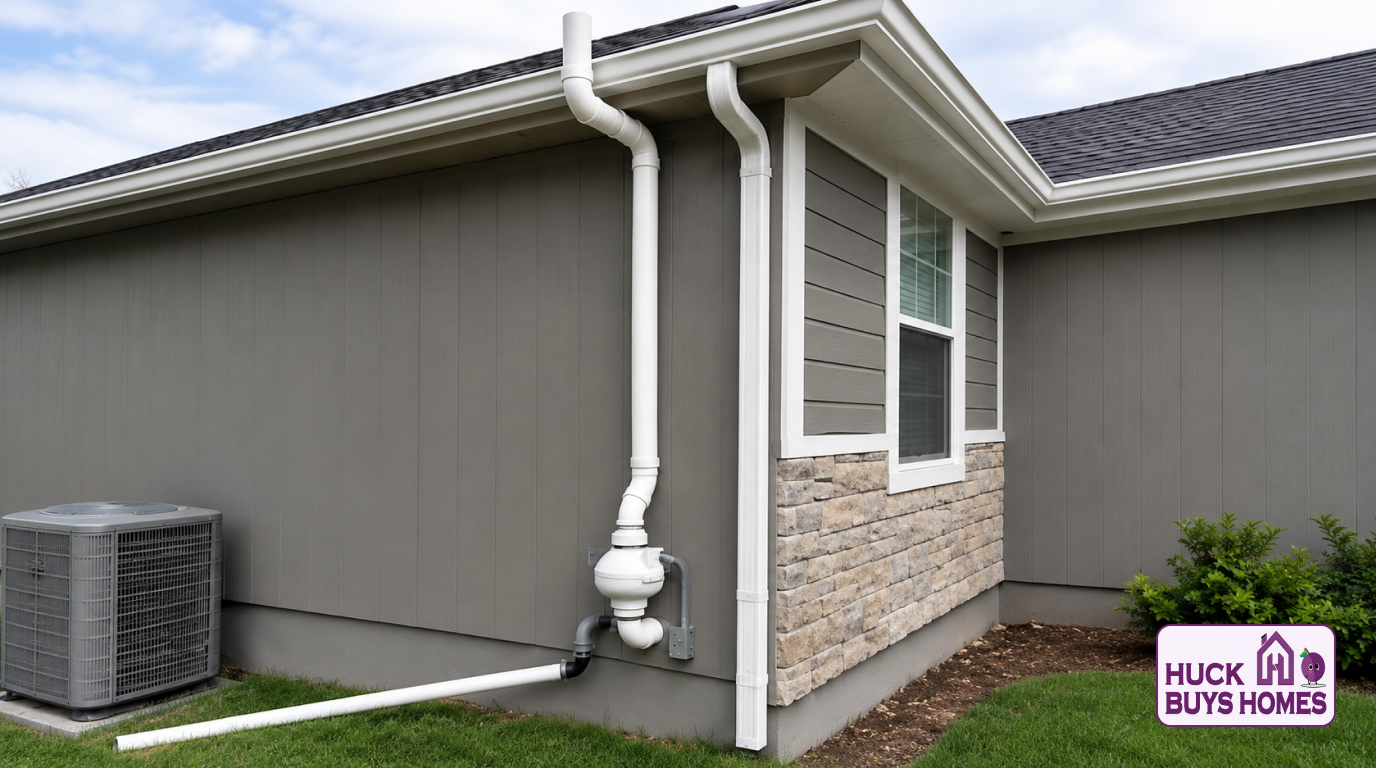
The flip side is reassuring. Radon mitigation systems are common and effective in Kansas City. Certified professionals install fans and vent pipes that quietly run in the background, pulling radon from under the house and venting it outside.
From our side at Huck Buys Homes, we see radon as a manageable safety item, not a deal killer. When we buy, we’re comfortable purchasing houses as-is with radon concerns, as long as the test results are on the table and we can factor mitigation into the plan.
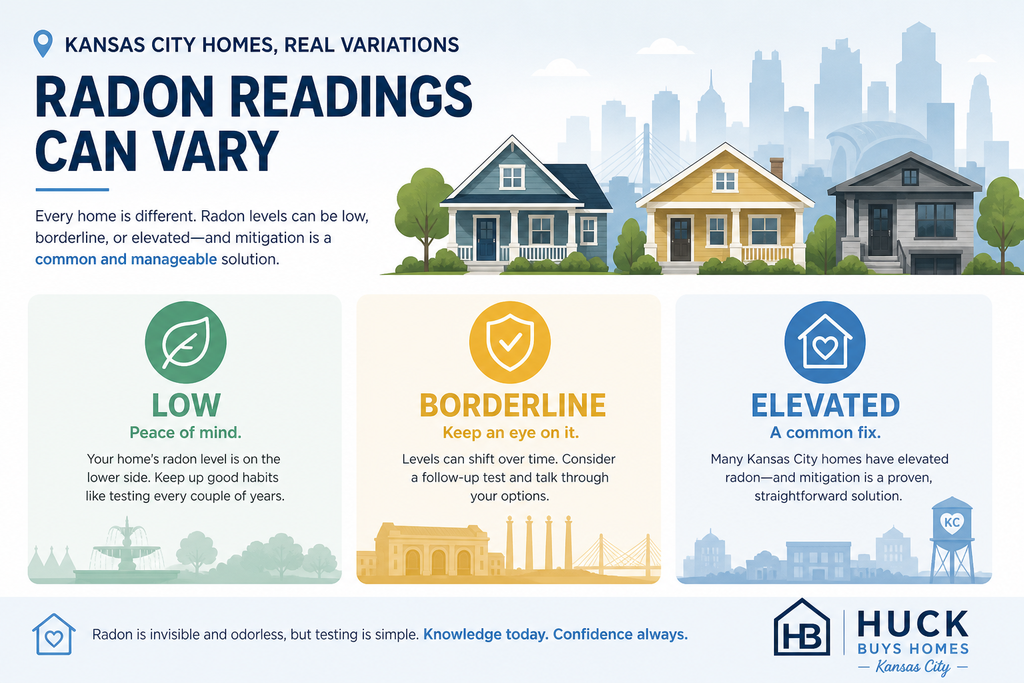
The honest answer is that Kansas City homeowners see a range of radon results. A radon report is not a verdict on whether your house can sell, it is information you use to make a plan.
Radon in air is measured in a unit called picocuries per liter, or pCi/L, and the EPA radon guidance uses an action level where mitigation is recommended. Tests generally fall into three rough categories:
| Category | What It Means | Typical Next Step |
| Low | A reading comfortably below the action level | Most buyers find this reassuring and may just plan to retest from time to time |
| Borderline | A reading close to the action level | Buyers and their agents often talk with a radon professional about options and may ask for mitigation or a credit |
| Clearly elevated | A reading noticeably above what health agencies recommend | In real estate deals, this usually triggers a request for mitigation or a negotiated price adjustment |
Across Kansas City, we see the full spread. Even on the same block, one house can be low while the one next door is high, since radon levels vary because of differences in foundations, soil conditions, and how each home is sealed and used.
Radon is a serious health risk, but it is a long-term risk that doesn’t make you sick overnight. Major health agencies, including the EPA, explain that breathing elevated radon over many years can raise lung cancer risk. The risk is higher when:
That’s why testing and mitigation are worth doing even if you’ve lived in the house a long time. If you’re worried about past exposure, especially if you’re a current or former smoker, talk with your doctor.
On our side as long-term owners of Kansas City properties, our plan is straightforward: test, mitigate when needed, and retest to confirm the system is doing its job.
The common myth is that a neighbor’s good test means your house must be okay. The truth is simpler and less convenient: any Kansas City home can have high radon, and testing is the only way to know. Here’s how radon can enter different types of foundations:
A few other factors that affect radon levels:
A quick myth-versus-reality snapshot:
As buyers, we treat every property on its own facts and plan around whatever the radon tests show.
The basic choices are straightforward: a low-cost DIY kit or a professional. Short-term tests run for a matter of days and are the most common in Kansas City home sales because everyone is working within an inspection window. Long-term tests run for months and give a better picture of average exposure, but are less common in active transactions.
| Factors | DIY Kit | Professional Testing |
| Where to get it | Local hardware stores, big-box home centers, online retailers, state or county radon programs | Certified radon testers or home inspectors |
| How it works | A small device placed at the lowest level of the home, mailed to a lab afterward | Electronic or continuous monitors set in the home for a short test period |
| Turnaround | Slower; depends on lab processing | Faster, with clearer reporting for buyers, agents, and lenders |
| Typical cost | Tens of dollars | Low hundreds of dollars |
| Best for | A first look outside of a contract deadline | Real estate transactions needing built-in checks against tampering |
For both DIY and professional tests, you’ll often be asked to keep the home in closed-house conditions, meaning keeping windows closed, limiting how often exterior doors are opened, and avoiding big fans or systems that rapidly move indoor air outside.
How testing fits into a Kansas City sale
In a traditional sale, the buyer or their inspector usually orders the radon test during the inspection period. High results can trigger a request that the seller install mitigation before closing, a request for a credit or price reduction, or in rare cases, a buyer walking away.
In our purchases at Huck Buys Homes, we try to keep this simpler. If there’s a recent test, we can often work from that. If there isn’t, we can order our own testing on our schedule after we go under contract, or even after closing in some cases.
A high radon test does not mean you are stuck. A radon problem makes planning necessary, not selling impossible. Here’s a simple roadmap many Kansas City homeowners follow:
When we buy houses with high radon, we usually structure our offer so we take on the project, either pricing in the expected cost of mitigation and handling it after closing, or moving forward as-is and scheduling the system on our own timeline.
In most Kansas City homes, radon mitigation is a straightforward mechanical system, not a full remodel. The most common setup, active soil depressurization, works like this:
What mitigation usually costs in our area
Without naming specific price tags, many standard single-family systems land in the low-to-mid thousands of dollars, and more complex homes can cost more. There are also small ongoing costs:
Many Kansas City buyers actually see an existing mitigation system as a plus, since it tells them the issue was found and documented.
A standard air purifier is not considered a full fix for radon. Air purifiers can help with dust, allergens, and some pollutants, but they don’t address radon.
Because mitigation is such a known project type for us, we regularly budget for these systems when we buy, so selling as-is and letting us handle mitigation after we own the house can be a less stressful path.
The fear is that radon will scare off every buyer. In reality, you have options, and different paths fit different life situations. Most sellers in Kansas City end up choosing one of three basic paths:
We buy houses in any condition, including Kansas City homes with known or suspected radon issues. Because we use our own capital, we don’t have to wait on lender approval tied to radon repairs. We simply look at the property, estimate the cost of mitigation, and build that into our cash offer.
For a homeowner behind on payments who can’t risk a deal falling apart, an heir selling a KC house from out of state, or a tired landlord who doesn’t want contractors in occupied units, not having to manage mitigation can be a huge relief.
A local cash buyer can make that load lighter. We don’t need lender approval, we know Kansas City housing stock from old basements in the urban core to newer slabs in the suburbs, and we price issues like radon into the offer upfront instead of asking you to fix them before closing.
If you’re sitting on a Kansas City house with radon concerns and feel stuck, Huck Buys Homes buys houses across th