

You’ve been sitting at your kitchen table, kids finally asleep, staring at that stack of bills. A lease notice on the counter, maybe a job you’re not sure about, and five browser tabs all asking the same thing: what’s the Kansas City housing market actually like right now?
You’re not just curious—you’re wondering if selling your Kansas City house and resetting somewhere more manageable is the only real exit. Here’s the short answer: Kansas City is an affordable, steady-demand market with strong investor interest, and understanding it changes how far your home equity can stretch.
Whether you’re thinking of holding, selling, or reinvesting, this guide breaks down the KC market in plain English—and how a local cash buyer can make your next step a lot simpler.
The Kansas City housing market spans a large metro area across both Missouri and Kansas—from downtown KC and its surrounding urban neighborhoods to quieter suburbs like Overland Park, Lee’s Summit, and Blue Springs. It’s not one zip code; it’s a region with dozens of distinct micro-markets worth understanding on their own terms.
According to Redfin’s Kansas City market data, the metro has shown steady, modest appreciation in recent months—properties moving in roughly 18 days on average and median prices staying meaningfully below coastal U.S. cities. That consistency is exactly what draws both owner-occupants and investors.
Here’s what that looks like in practical terms for someone with a Kansas City home they’re thinking about selling:
| Market Metric | Kansas City, MO | What It Means for You |
| Price level vs. U.S. median | Generally at or below national median | More buyers can qualify; your equity stretches further when reinvesting |
| Days on market | Moderate (steady pace) | Not a frantic bidding war, but not stagnant either |
| Inventory | Moderate supply | Buyers have choices; sellers who price right still move quickly |
| Investor interest | High — ranked top 3 nationally for cash flow | Strong demand from investors supports price floor |
The bottom line: Kansas City gives buyers and investors room to find deals without the chaos of peak-boom bidding wars every weekend. If you own a home here, your equity is sitting in a stable, in-demand market—not a bubble waiting to pop.
Whatever KC looks like on paper only matters once you know what you’d actually walk away with after carrying costs, repairs, and closing fees are accounted for. To understand your real net proceeds without the guesswork, see how Huck Buys Homes handles the process.
The fear is real: you don’t want to sell now and watch prices dip, or hold on and miss the right window. Kansas City’s midwestern market tends to move in smaller steps than coastal boom markets, with prices that shift gradually rather than spiking or crashing overnight. That’s actually a feature, not a bug, for long-term owners.
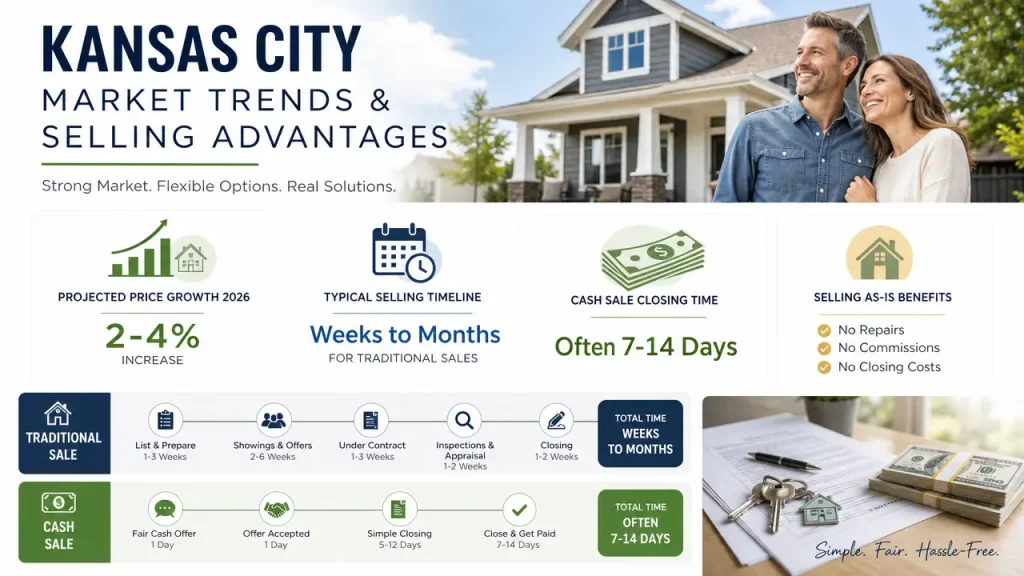
The 2026 housing market outlook from KCTV5 points to improving conditions as rates ease, with new construction filling gaps and first-time buyer activity picking back up. Analysts project modest 2–4% price growth in 2026—not a boom, but steady forward movement.
Mortgage rate swings show up clearly in KC: when rates climb, some buyers step back and homes sit a bit longer. When rates ease, demand picks back up and competition tightens in popular suburbs. Here’s a simple if/then framework for the next 12–24 months:
● If rates stay elevated: expect flatter prices, longer days on market, and more leverage for cash buyers and patient sellers.
● If rates ease further: modest price growth returns, especially in well-located, move-in-ready homes.
● For buy-and-hold owners: over a 5+ year horizon, steady cash flow and buying within budget matter far more than timing a perfect entry month.
One concrete scenario: a tired Kansas City landlord with a duplex that’s constantly eating profits in maintenance and vacancy costs. The real question isn’t whether the market will go up next quarter—it’s whether the property makes sense to hold versus getting a clean cash number now and repositioning.
You’ve heard Kansas City called a “cash-flow market.” That label is earned, but it’s not the whole story. Here’s what actually drives investor interest—and what you should watch out for before idealizing it.
Kansas City ranked #3 nationally for rental property investing in 2026, driven by a median home price roughly 16% below the national average, strong rent-to-price ratios, and a diversified economy with job growth spanning healthcare, logistics, finance, and technology—including new large employers like Panasonic and Google expanding operations in the metro.
The investor thesis in plain terms:
● Lower purchase prices than coastal markets mean lower barriers to entry and better initial cash flow from day one.
● Steady renter demand from a diverse workforce spanning healthcare, tech, logistics, and finance — not a single-industry city that crashes when one employer leaves.
● Rent-to-price ratios that can support genuine cash flow when a property is bought right and managed well—not just on paper.
● Landlord-friendly environment with efficient courts in Missouri and no statewide rent control pressuring margins.
The types of properties investors actually target in KC are everyday workforce housing: solid 3-bed single-family homes, small duplexes, and well-maintained properties in stable, lived-in neighborhoods—not luxury condos or fringe speculative developments.
The risks a KC homeowner should keep in mind: distance management is real, property condition surprises happen, and picking the wrong block or property manager can erase the ‘great deal’ on paper before year one ends.
Huck Buys Homes applies the same cash-flow-first, no-nonsense lens when buying Kansas City houses—focusing on realistic numbers and livable properties, not speculation. See how the Huck Buys Homes process works.
If you’re a Kansas City homeowner weighing whether to sell locally and reinvest here or elsewhere, a quick comparison helps. The metrics below are directional—conditions shift, so always verify current data from sources like Redfin or Zillow before making decisions.
| Market Factor | Kansas City, MO/KS | Coastal / High-Cost Markets |
| Typical price level | At or below national median | Well above national median |
| Ownership costs | Lower property tax, no coastal premiums | Higher insurance, storm wear, flood risk |
| Market feel | Steady, Midwestern, gradual movement | Volatile swings tied to migration/tech cycles |
| Investor appeal | Cash flow focus; strong rent-to-price | Appreciation focus; low rental yield |
| Affordability trend | Improving as wages keep pace | Strained; affordability a persistent issue |
The appreciation vs. cash flow contrast is worth dwelling on. Coastal markets can deliver lifestyle upside and occasional appreciation pops tied to in-migration waves—but when those waves recede, owners feel it in insurance, maintenance, and softening prices. Kansas City appeals to investors prioritizing steadier rent-to-price balance, even if appreciation is slower and less dramatic.
The only KC comparison that truly matters is what you’d actually net after repairs, commissions, closing costs, and holding time—not the headline list price. A simple scenario: you sell your Kansas City home as-is to a cash buyer, know your net proceeds in days, and then calmly decide whether to reinvest locally, buy somewhere new, or pay off debt entirely.
There’s a reader who just got off a stressful call about a missed payment or a tenant who hasn’t paid in two months, and then opened an investment blog that made KC real estate sound like a side hustle waiting to happen. That’s not the right moment to complicate things further.
Some situations where getting a clean, fast cash offer on your Kansas City house is the smarter first step:
● Pre-foreclosure or missed payments: Every month matters. A quick sale stops the clock and protects your credit.
● Inherited or vacant house: A vacant KC home accumulates taxes, insurance, and maintenance. Selling as-is removes the drag quickly.
● Divorce or estate settlement: When two parties need a clean exit, a cash sale eliminates the negotiating and waiting. See how divorce home sales work in KC.
● Tenant problems: A tenant who won’t leave or won’t pay is draining money every month. Selling with tenants in place is an option.
● Major repairs you can’t fund: Roof, HVAC, foundation issues—a cash buyer takes the property as-is without negotiating over every line on the inspection report.
The emotional cost of trying to “play investor” while your KC life feels like it’s on fire is real. Stress, time away from work and family, and rushed decisions in an unfamiliar financial position all compound the problem. Sometimes the smartest investment move is the simplest one: get your KC equity out cleanly, then decide what comes next from a position of strength.

For long-term owners and buy-and-hold investors, Kansas City’s steady, affordable profile still makes sense in 2026—but this is not a market you should jump into hoping for fast appreciation. It rewards patience, realistic numbers, and a 5+ year horizon, not a 6–12 month flip mentality.
| Your Situation | Suggested Focus | Key Question to Answer First |
| Owner-occupant moving for work/life | Stability & neighborhood fit | Does the monthly payment work if circumstances change? |
| Buy-and-hold investor | Cash flow & long-term rent growth | Does rent cover mortgage, taxes, insurance + reserves? |
| Stressed seller considering a move | Sell cleanly first; buy later | What is my real net after KC closing and carrying costs? |
| Landlord tired of management headaches | Sell as-is; redeploy capital | Is holding worth the monthly stress and expense? |
1. Your monthly payment and reserves still work if rents soften by 10–15%.
2. You’re buying for a 5+ year horizon, not expecting to flip in under a year.
3. You’ve cross-checked KC numbers from multiple sources—not just one article or one AI summary.
For Kansas City sellers specifically: the first decision is whether to sell at all, and if so, whether to list traditionally or sell as-is. Understanding the full cost of selling a Kansas City home is the foundation of any smart next move—before the KC timing question even becomes relevant.
Five browser tabs open, KC blogs, price charts, AI summaries, and you’re more confused than when you started. That’s common. Here’s a practical, no-hype research method you can work through from your kitchen table:
1. Check major portals for KC overviews. Start with Zillow Kansas City market data and Redfin for general price trends and days-on-market charts. Look for patterns over 6–12 months, not a single month’s data.
2. Cross-check with investor-focused sources. Sites that track cap rates, gross yield, and cash-on-cash returns show you what serious investors—not just homebuyers—are seeing. KC consistently shows up as a top cash-flow market in 2026 rankings.
3. Talk with a local KC agent or property manager. No online chart tells you which blocks are softening, which streets have tenant turnover problems, or where new development is changing the neighborhood dynamic.
4. Lay KC numbers next to your own Kansas City equity picture. If you’re considering a move or reinvestment, start by knowing what you’d actually net from a KC sale. That number—not a list price—is your real working capital.
5. Get a no-obligation cash offer as a baseline. While you’re doing this research,