

You just learned your roof is near the end of its life. Maybe an inspector flagged it, or a roofer delivered the bad news. Now a replacement estimate sits on your table, and you wonder is selling a house with an old roof in Kansas city a possibility?
The good news is simple. You can sell a house with an old roof in Kansas City. It just changes your options, your likely buyer, and how the deal is structured.
This guide covers how buyers, lenders, and insurers view aging roofs. It also explains disclosure rules, pricing strategy, and cash-sale tradeoffs. By the end, you can compare your options using real numbers instead of guesswork.
Picture your Northland ranch or Waldo bungalow during inspection. The inspector climbs down and says the roof is near the end of its useful life. That does not make your home unsellable. It changes who buys, how hard they negotiate, and how closely lenders and insurers look.
Buyers and inspectors care about condition more than age alone.
A roofing contractor can typically assess the roof’s condition, identify existing or potential problems, and outline what repairs or replacement would involve before the home goes on the market.
Most financed buyers must carry homeowners insurance, which explains why mortgage lenders require homeowners insurance before closing. If an insurer dislikes the roof, coverage questions can stall the deal. Roof rules vary by company, so there is no universal age cutoff.
| Who Looks at the Roof | What They Focus On | How It Affects Your Sale |
| Buyers | Visible wear and leak stains | Lower offers or repair requests |
| Home inspectors | Remaining useful life | Repair or replacement recommendations |
| Lenders | Insurability of the property | Possible delays in loan approval |
| Insurers | Condition, material, and claim history | Coverage limits, conditions, or denial |
Kansas City weather adds pressure. Hail, heavy rain, ice, and long hot summers all wear down shingles over time. The National Weather Service offers local climate resources for background on regional weather patterns. Prior hail claims or patch jobs may also come up during insurance reviews.
• Older KC neighborhoods: Buyers often expect a mix of aging systems and future projects.
• Newer Johnson County subdivisions: Buyers may expect a recent roof and react more strongly to wear.
If your home also has storm-related water issues, our guide to basement flooding in Kansas City covers next steps.
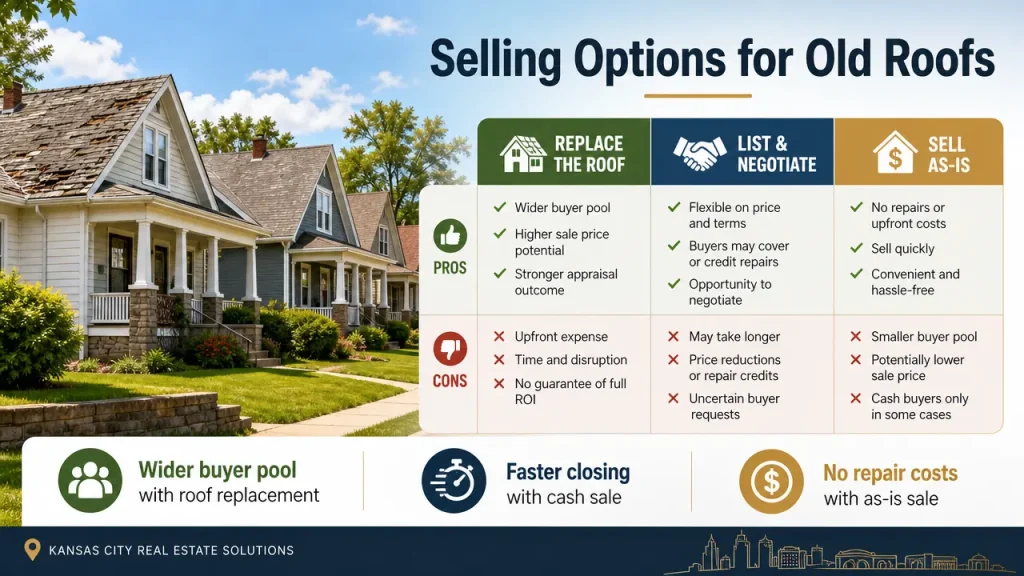
You are at your dining table in Overland Park or Gladstone, staring at a roofing bid. The total is bigger than expected. You do not always have to replace the roof before selling. The right move depends on budget, roof condition, buyer expectations, and your energy level.
| Option | Main Benefits | Main Drawbacks | Best For |
| Replace before listing | Wider buyer pool, fewer roof repair requests | Upfront cost, crews, noise, uncertain payback | Sellers with cash and time |
| List and negotiate | No upfront roof bill | Credits, delays, and possible buyer walkaways | Sellers who can handle back-and-forth |
| Sell as-is for cash | No repairs, fewer showings, faster closing | Lower price than a fully updated home | Sellers short on time or funds |
Replacing the roof can make your listing more competitive. However, you may not recover every dollar through a higher price. If the bill drains your savings, the best option on paper may feel wrong in real life.
Listing without replacing means the roof conversation happens after inspection.
Selling as-is means you disclose the roof honestly but promise no repairs.
Inherited a house with roof trouble? Our overview of the Kansas probate process explains what Kansas City families should expect.
You are days from closing when your agent calls. The buyer’s insurer will not write a policy because of the roof. For a financed buyer, that can threaten the entire sale.
• After inspection: The insurer reviews photos or the report and balks.
• During underwriting: The lender spots roof concerns and asks more questions.
• Late in the process: The insurer decides it will not cover the roof as-is.
Some insurers offer coverage only if repairs happen within a set timeframe. Others decline outright. The Insurance Information Institute explains how much homeowners insurance a homeowner may need and why carriers weigh property condition. Each company uses its own rules, so another carrier may say yes.
No Missouri or Kansas rule automatically decides who pays for roof work. Buyer and seller negotiate within the contract terms.
This article is general information, not legal or insurance advice. Talk with a licensed insurance agent and a local real estate attorney about your contract.
Cash buyers remove the lender from the equation. With no loan, an insurer’s opinion is less likely to stop closing.
You are staring at a seller’s disclosure form, pen hovering over the roof section. You remember past leaks and worry honesty will scare buyers away. In both states, sellers are generally expected to disclose known material defects.
Material defects are problems that could reasonably affect a buyer’s decision or price. Roof items that usually belong on the form include:
• Complete the form honestly based on what you actually know.
• Share paperwork such as inspection reports, roofer bids, and claim letters.
• Let buyers review with their agent and inspector before deciding.
Hiding roof issues can lead to delayed closings, angry buyers, or legal claims. Missouri sellers can review Missouri Revised Statutes Chapter 339 for the legal framework. Kansas sellers can check guidance from the Kansas Real Estate Commission. Rules differ by state, so see our guide on selling a house in Kansas City Kansas vs Missouri.
This is general information only, not legal advice. If a disclosure question worries you, talk briefly with a Missouri or Kansas real estate attorney.

Your agent pulls recent sales during the listing appointment. A nearby home with a newer roof sold strong. Your agent suggests a lower price, and it feels unfair. But buyers subtract roof costs plus a hassle buffer for the stress involved.
• Price below pristine comps: List under similar homes with newer roofs. This draws serious buyers and reduces painful renegotiations later.
• List near market value: Start high and expect roof credits after inspection. This invites more negotiation and possible delays.
• Accept an as-is cash offer: The roof cost is priced in upfront. The number is lower, but closing is faster and simpler.
Focus on net proceeds, not the headline contract price. A higher price with big roof credits may leave you with less. Carrying costs and weeks of negotiation also eat into your profit. A cleaner as-is sale can sometimes come out closer than expected.
Ask your agent for a net sheet for each scenario. Include roof credits, closing costs, carrying costs, and expected days on market. Then compare that number to any as-is cash offer you receive. The highest list price is not always the best outcome.
For current trends, read our breakdown of the Kansas City housing market.
Maybe you already lost one buyer over the roof. Or every offer arrives loaded with repair demands. Selling to a cash buyer or investor can be a legitimate option when you understand the tradeoffs.
| Factor | Cash Buyer | Traditional MLS Buyer |
| Lender approval | Not required | Required |
| Roof repairs | Priced into the offer | Often requested before closing |
| Showings and inspections | Usually one walkthrough | Multiple showings and full inspection |
| Insurance-related fallout | Lower risk | Higher risk with an old roof |
| Sale price | Usually lower | Usually higher, minus credits |
Cash buyers nearly always buy at a discount. They take on repair costs, holding costs, and market risk. That discount is not unique to Huck Buys Homes. It is how this part of real estate works.
• Inherited homes with worn roofs and no spare estate funds
• Landlords with storm-damaged rentals and no roof budget
• Owners behind on payments who cannot wait on contractors
Huck Buys Homes is a local Kansas City buyer.
Dealing with more than roof damage? See what to do about burst pipe water damage in Kansas City and when selling as-is makes sense.
It is late, and you have a legal pad out. The more you read online, the more overwhelming it feels. You just want clear steps.
• Assess the roof: Look for missing shingles, dips, stains, and past patches.
• Gather documents: Collect invoices, claim paperwork, photos, and warranty details.
• Talk to local pros: Ask an experienced agent and roofer how buyers react.
• Run real numbers: Compare repair-and-list costs against an as-is sale.
• Pick your lane: Replace, list and negotiate, or sell for cash.
• Prepare disclosures: List everything you truly know about the roof’s history.
• Choose a buyer path: Go MLS, stay open to investors, or contact a cash buyer.
Having a plan makes negotiations less stressful. You already know your limits on roof costs and your backup plan. Huck Buys Homes can review your roof bids and explain how they budget for repairs. They can also serve as a backup if a traditional buyer’s insurer says no.
Whatever path you choose, keep copies of every bid, report, and email. Organized records protect you during negotiations and disclosures.
If you are done with contractors and repair negotiations, request a no-pressure, as-is cash offer. Compare it to your traditional-sale options, then decide what feels right.
Yes. Most deals still close by repairing the roof or renegotiating price and credits. Your options depend on contract deadlines and insurer rules, so consult your agent and, if needed, a real estate attorney.
No fixed rule decides who pays. Buyer and seller negotiate within the inspection, financing, and contingency terms of their contract. Outcomes include seller repairs, split costs, or price credits.
There is no single age that makes a roof too old to sell. Insurers set their own guidelines based on material, condition, and risk.
Not always. It depends on your budget, roof condition, and local buyer expectations. Also consider how likely the roof is to trigger inspection or insurance problems.
Yes. You can sell as-is if you disclose what you know and price the home so a buyer can afford repairs. Expect a lower price in exchange for skipping the work.
No. The offer reflects the home’s as-is condition. Sharing photos, invoices, or roofer estimates upfront helps make the offer more accurate.

We buy houses fast in any condition. No repairs, realtors, fees, or commissions. Call Us 816-670-3480