

You just walked out of the funeral home. Your aunt handed you a folder and said the lawyer says you are the executor. Now you are staring at your parent’s house in Overland Park or Kansas City, KS, wondering what probate actually means and whether you will be paying taxes and mowing that lawn for the next two years.
The short answer: Kansas probate is a court-supervised process, and the house does not have to sit idle forever. Most families have workable paths, including selling during probate, once they understand how the Kansas probate process actually works.
Probate is the legal process that settles a person’s estate after death — validating the will if one exists, paying valid debts, and transferring what’s left (including the house) to heirs.
According to Kansas Legal Services, all probate proceedings in Kansas are handled by the District Court in the county where the deceased lived or owned property. The court supervises the executor’s actions and makes final decisions on large debts and distributions.
Having a will does NOT automatically skip probate. A will is the document that gets probated — the court’s job is to confirm it is valid and that its instructions are followed. This surprises a lot of families in the Kansas City area who assumed a will was enough.
On both the Kansas and Missouri sides of the metro, the basic framework is the same: court-supervised process, appointed executor, creditor notice period, then distribution. The court names and some terminology differ, but the stress on the family is identical.
● Kansas probate: Handled in district courts at the county level; executor is appointed through the court
● Missouri probate: Similar structure; slightly different court terminology — Kansas City families with property in both states may face two separate proceedings
● Key point: The executor (or administrator, if there is no will) manages the estate under court oversight and is personally responsible for proper handling
● Non-probate assets: Joint tenancy property, life insurance with named beneficiaries, TOD accounts, and properly funded trusts can bypass probate entirely
You are staring at a copy of the deed you dug out of a file cabinet. Only your dad’s name is on it, and someone just told you that means a long court fight before you can sell. Here is how to read the situation:
| Situation | Probate Required? | Who Signs to Sell? |
| Home in decedent’s name only | Yes — must go through estate | Court-appointed executor/administrator |
| Home in joint tenancy with right of survivorship | No — passes automatically to survivor | Surviving owner (with death certificate) |
| Home with Transfer-on-Death (TOD) deed recorded | No — passes to named beneficiary | TOD beneficiary (with proper filing) |
| Home held in a funded trust | No — trust controls distribution | Trustee per trust terms |
Kansas law recognizes TOD deeds for real estate, which let a homeowner designate a beneficiary who receives the property directly on death — no full probate needed. But that deed must be properly recorded and executed before death. If it was not, the house almost certainly goes through probate.
Title companies in Kansas and Missouri will insist on seeing the correct court orders, letters testamentary, or recorded deeds before insuring a sale. Heirs cannot simply decide to sell without the proper paper trail — even if everyone in the family agrees.
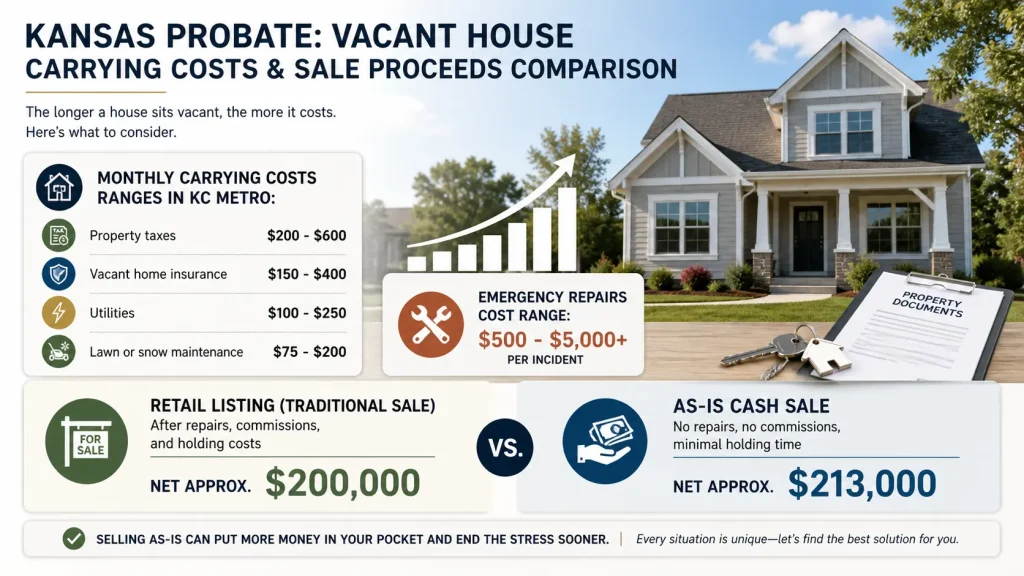
Nobody has given you a straight answer on timing. Here is what the Kansas probate sequence actually looks like — and where the house sale fits in:
● Step 1 — File Probate Petition (within 6 months of death): The petition is filed in the county district court. The will is presented for validation.
● Step 2 — Court Appoints Executor (approx. 4-5 weeks): Letters testamentary are issued, giving the executor legal authority to act on behalf of the estate.
● Step 3 — Inventory and Appraise Assets: The executor catalogs all estate property, including the house, and arranges an independent appraisal or valuation.
● Step 4 — Notify Creditors (4-month claim window): Creditors have 4 months from actual notice to file claims. This period must run before the estate can be fully closed.
● Step 5 — Decide on the House Sale: The executor and attorney decide whether selling serves the estate. Court approval may be required for the specific sale.
● Step 6 — Pay Debts and Estate Expenses: Valid creditor claims, mortgages, taxes, and legal fees are paid from estate funds, often including house sale proceeds.
● Step 7 — Distribute Remaining Assets to Heirs: After debts are cleared, what is left goes to beneficiaries per the will or Kansas intestacy law.
● Step 8 — Close the Estate (no earlier than 6 months after death): The court issues a final order and releases the executor from duties.
Kansas probate timelines commonly run several months to over a year depending on estate complexity, family disputes, and court scheduling. A critical Kansas rule: no estate with assets beyond the allowance can be closed earlier than 6 months from the date of death, regardless of how quickly everything else moves.
The house sale typically happens after Step 2, but must wait until the attorney confirms the timing is right — especially if court approval of the specific sale is required. A cash buyer can make an offer early and simply wait to close until the attorney gives the green light.
Many families are told they cannot sell until probate is closed. That is often not accurate. In most Kansas cases, the executor or administrator — acting under court authority — can sell the property during probate. Kansas probate law allows this, provided the correct procedures are followed and proceeds stay in the estate to pay debts and later distribute to heirs.
Here is how a typical Kansas probate house sale works in practice:
● Executor receives letters testamentary from the court, establishing legal authority
● Executor and attorney agree that selling the house serves the estate’s best interests
● Executor signs the purchase agreement on behalf of the estate — not as an individual
● Court approval is requested and obtained if required for that specific transaction
● Title company closes the sale; proceeds go into the estate account, not directly to heirs
● Debts and expenses are paid; remaining funds are distributed to heirs per court order
The buyer and title company will demand letters testamentary, proof of court authority, and confirmation that liens and outstanding taxes are addressed. This is why cash buyers with probate experience are attractive — there is no lender appraisal, no financing contingency, and closing dates can match the court calendar rather than fight it.
| Scenario | Gross Price | Estimated Deductions | Approx. Net to Estate |
| Retail listing (after repairs + agent) | $240,000 | $18K repairs + $14K commissions + $8K holding costs | Approx. $200,000 |
| As-is cash sale (Huck Buys Homes) | $215,000 | No repairs, no commissions, minimal holding time | Approx. $213,000 |
These are illustrative numbers, not a guarantee — but they show why the as-is path often nets the estate more, even at a lower headline price. Kansas City families going through probate frequently discover this math when they sit down and run the actual numbers.
You are unlocking a dark house for the third weekend in a row, wondering what you are supposed to be doing as executor besides checking for leaks. Here is the practical answer:
● Secure the property: Change locks if needed, confirm doors and windows are sealed. A vacant house is a liability.
● Maintain insurance: Standard homeowners policies often exclude vacant homes after 30-60 days — arrange vacant-home coverage immediately.
● Handle utilities: Keep water and heat on in winter to prevent pipe damage; address any city code notices promptly.
● Arrange a valuation: Get an appraisal or CMA to establish the property’s value for the estate inventory.
● Do not let one heir take over: Until the estate authorizes it, no single heir can move in, rent the property, or make changes. The executor’s duty is to all beneficiaries.
● Document everything: Keep receipts for all expenses paid from estate funds — the court will review the final accounting.
Common family flashpoints: one sibling wants to hold it as a rental; another in Denver just wants cash now; a third has not responded to emails in two weeks. The executor must follow the will and Kansas law — not a family vote. A Kansas probate attorney is the right person to call when those disputes escalate.
The executor is legally responsible for preserving the property but does not have to personally manage every showing or repair. Huck Buys Homes routinely works with executors in the Kansas City metro — buying as-is, coordinating junk removal if needed, and closing on a schedule that fits the probate attorney’s plan.
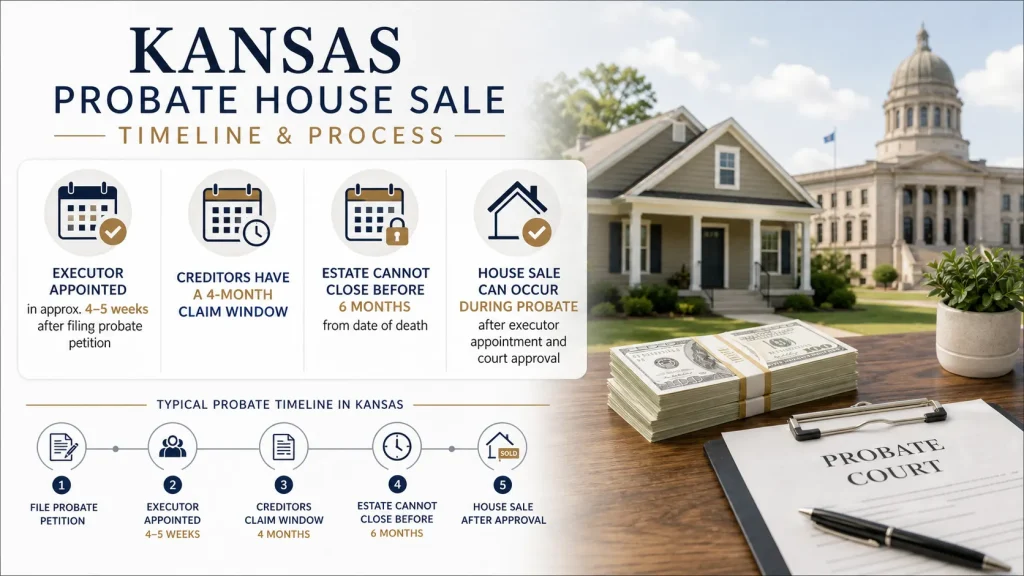
You add up a few months of property taxes, insurance, utilities, lawn care, and a roof patch — and realize you have spent thousands keeping a place nobody wants. These carrying costs are a real drain on the estate:
| Cost Category | Typical Monthly Range (KC Metro) | Notes |
| Property taxes | $200 – $600/mo | Assessed by county; due whether property is occupied or vacant |
| Vacant home insurance | $150 – $400/mo | Standard policies often exclude vacant properties after 30-60 days |
| Utilities (water, gas, electric) | $100 – $250/mo | Often kept on to prevent freeze damage in winter |
| Lawn or snow maintenance | $75 – $200/mo | City code violations possible if grass or snow is neglected |
| HOA dues (if applicable) | $0 – $300/mo | Most KC metro HOAs continue to assess regardless of vacancy |
| Emergency repairs | $500 – $5,000+ per incident | Roof leaks, burst pipes, and vandalism can hit without warning |
A house sitting vacant for 9-12 months during probate can absorb $15,000 to $30,000 or more in carrying costs and unexpected repairs. On the tax side: the IRS generally provides a step-up in basis for inherited property, meaning heirs are typically taxed only on gains above the property’s value at the date of death — not the original purchase price. Kansas does not currently impose a separate state estate or inheritance tax, though a Kansas Inheritance Tax Waiver filed with the Register of Deeds may still be required for older estates. Speak with a tax professional for specifics.
This is where Huck’s model makes a practical difference. We cover closing costs, charge no commissions, and buy as-is — so the estate stops the monthly bleed as soon as the attorney confirms it is time to close. Families working through selling an inherited or probate property often find the math works out better than expected once the full holding-cost picture is on the table.
You are standing in the living room of a Kansas City, KS house packed with 40 years of belongings. Your siblings are texting nonstop from out of state. Here is what we see all the time in Kansas City, and how we usually help:
● Out-of-state heirs: Multiple family members scattered across the country cannot coordinate showings or manage repairs. A single cash offer, one decision, one closing date — everyone signs remotely.
● Houses full of belongings: Huck buys as-is, including homes packed with furniture and decades of personal items. Take what you want and leave the rest.
● Serious deferred maintenance: Roof issues, outdated electrical, foundation cracks — traditional buyers and their lenders often will not touch it. We price condition into the offer and move forward without a repair list.
● Vacant house through winter: Every week a KC-area house sits vacant in January brings another risk of burst pipes or vandalism. Closing quickly stops the exposure.
● Tenant-occupied inherited rentals: We buy tenant-occupied properties. You do not have to navigate a Kansas eviction process before you can sell.
● Siblings who cannot agree: A firm cash offer with a clear closing date sometimes breaks the deadlock better than months of family debate.
Our team is based in Kansas City, not a national call center. We know the difference between Wyandotte County probate court and Johnson County, and we work regularly with local probate attorneys and title companies on both the Kansas and Missouri sides.
If you are weighing what carrying costs versus a quick sale look like on paper, our blog post on how long it takes to sell a house in Kansas City walks through the math on time-to-close for different sale paths.
Some families reading this are early in the process and do not know yet whether selling is even on the table. If there are multiple wills, disputed claims, or siblings who cannot agree on basic decisions, legal help comes first. Kansas Legal Services provides free or low-cost assistance to qualifying Kansans navigating probate. For more complex estates, a licensed Kansas or Missouri probate attorney is essential.
Huck is not a law firm and cannot give legal advice. We respect that probate decisions are legal questions first. Here is a simple three-step sequence we would suggest:
● Talk with a Kansas probate attorney or legal-aid organization to understand your obligations and options
● Meet with family (or get agreement from co-heirs) on whether selling the house fits the estate’s plan
● When selling as-is makes sense, contact Huck for a no-obligation cash offer structured around your probate timeline
When the time comes to deal with the house, we are ready to make that part of the process a lot simpler — no repair project, no showings, no waiting on bank approval, no commissions, and no surprise closing costs. One call, one offer, one closing date that fits your attorney’s calendar.
Reach Huck Buys Homes at 816-670-3480 or visit huckbuyshomes.com.
What is probate in Kansas?
Probate is the court-supervised process that validates a will, appoints an executor, pays valid debts, and transfers remaining property — including a house — to heirs. Kansas probate is handled by the district court in the county where the deceased lived or owned property.
Can I sell a house during probate in Kansas?
Usually yes. The court-appointed executor can sell estate real property during probate without waiting for the case to close, provided proper procedures and any required court approvals are followed. Huck Buys Homes regularly structures as-is cash sales around probate timelines so closing happens when the attorney confirms it is ready.
Do I always need probate to sell inherited property in Kansas?
Not always. Homes held in joint tenancy, with a recorded TOD deed, or inside a funded trust may pass outside full probate. But if the house was titled solely in the decedent’s name with no special arrangement, probate is typically required. Your probate attorney and title company will confirm which path applies.
How long does the Kansas probate process take?
Most Kansas probate cases run several months to over a year. The executor is typically appointed within 4-5 weeks of filing. Creditors have 4 months to file claims, and no estate can close before 6 months from the date of death. Complex estates with disputes take longer.
What costs should I expect with a Kansas probate house?
Expect property taxes, vacant-home insurance, utilities, lawn or snow maintenance, HOA dues, and potential emergency repairs — often hundreds of dollars per month. Attorney fees, court costs, and debt payoffs also come out of the estate. A faster as-is sale can significantly reduce holding costs.
Does Huck Buys Homes work directly with probate attorneys?
Yes. We coordinate with your Kansas or Missouri probate attorney and the title company throughout the transaction — providing the purchase contract, staying flexible on closing dates, and making sure funds flow through the estate correctly. You handle the legal side; we handle the property side.