

You walked into the basement and heard it before you saw it — water roaring behind the wall, carpet soaking fast, and your mind already racing to the furnace, the kids’ stuff on the floor, and how on earth you’re going to pay for this. Burst pipe water damage in Kansas City home is one of those gut-punch emergencies that hits without warning, especially in the dead of winter when a deep freeze catches uninsulated pipes off guard.
This guide is for homeowners who need two things right now: clear, no-fluff steps to get through the next 24-48 hours, and an honest look at whether repairing everything is worth it — or whether selling the house as-is is the smarter move. Let’s walk through this together.
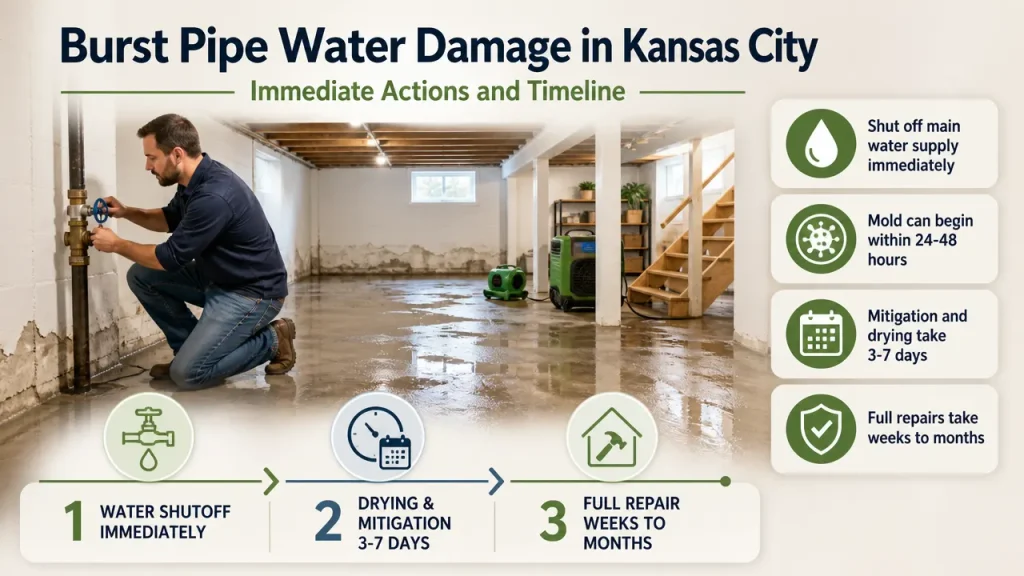
You’re standing in a cold Kansas City basement, hearing water roar behind the wall, unsure whether to cut the power, call 911, or just start mopping. Here’s what to do first. The single most important action in any burst pipe emergency is reaching the main water shutoff — and doing it fast.
In most Kansas City homes, the main shutoff valve sits near the front foundation wall in the basement, in the utility room, or in a crawl space. Older homes in areas like Waldo or Independence may have an exterior curb stop box near the sidewalk — you’ll need a curb key to operate it. Turn the valve clockwise until it stops.
1. Find and shut off the main water supply valve — basement front wall, utility room, or exterior curb stop box.
2. Check electrical safety: if water is near outlets, the breaker box, or your HVAC equipment, cut power at the main breaker or evacuate and call the utility company.
3. Evacuate any rooms with sagging ceilings or standing water over outlets — a bulging ceiling holds gallons and can collapse without warning.
4. Photograph and video everything before you clean a single drop — wide shots and close-ups of the pipe, walls, floors, and water extent. Write down date and time.
5. Call your homeowners insurance claims line immediately — get a claim number and follow any emergency mitigation instructions they give you.
Mold can begin colonizing damp drywall and carpet within 24-48 hours, per EPA guidance — so the first hour of action determines how much the repair bill grows. Kansas City’s freeze-thaw cycles mean bursts most often occur along exterior walls, unfinished crawl spaces, and behind finished basement walls. Acting fast isn’t optional.
If the situation feels dangerous — arcing electrical, visible structural collapse, or a gas smell — get everyone out and call 911. Once it’s safe, some homeowners in severe situations call a local cash buyer like Huck Buys Homes right after the water’s off and realize an as-is sale may be simpler than managing weeks of emergency trades and insurance battles.
Once the water is off, you’re staring at soaked carpet, buckling laminate, and wondering if grabbing a shop-vac and a box fan is enough — or if you’re about to make an expensive mistake. Here’s the honest truth: for small spills in one room with non-porous flooring, DIY mitigation can work. Once water goes deeper than half an inch across more than one room, or it’s soaked into finished basement drywall and insulation, you need professional help.
Start with what you can do right now. Use towels, mops, and a wet/dry vacuum to pull up standing water. Lift furniture onto foil or plastic-wrapped blocks to prevent further staining or swelling. Pull back carpet edges in soaked areas so the pad and subfloor can dry — watch for sharp tack strips and the sheer weight of waterlogged carpet.
Open windows when outdoor humidity is low. Run every fan and dehumidifier you have. In Kansas City’s humid summers, dehumidification is as critical as airflow — damp air alone won’t dry a soaked basement fast enough to stop mold.
● Drywall and insulation: saturated sections usually need to be cut out — wet insulation traps moisture and rarely dries in place.
● Laminate and engineered wood flooring: typically must be removed once swollen — they cannot be dried in place without buckling.
● Solid hardwood: may be salvageable with fast, aggressive drying, but professional assessment is wise.
● Subfloor and framing: squishy floors or musty smells after drying signal water in the structure — probe with a moisture meter or call a pro.
Professional restorers follow IICRC S500 standards for water extraction and drying — using commercial drying equipment and moisture meters to find hidden water that a box fan won’t reach. Even if you’re considering selling as-is, doing basic mitigation now keeps the home safer and makes it easier for a cash buyer to price the damage without guesswork.
You’re sitting at the kitchen table, policy app open, scared you’ll say the wrong thing and blow your coverage. Here’s what matters most: most standard homeowners insurance policies cover sudden, accidental burst pipe damage — but not long-term neglected leaks or external flooding from rivers. A burst that froze and let go overnight is generally covered; a slow drip that rotted your subfloor over two years is generally not.
Report the loss as fast as possible. Insurers can argue that delayed reporting allowed preventable additional damage — and that can affect your payout. Follow their mitigation instructions to the letter. Keep every receipt for emergency plumbing, equipment rentals, or hotel stays.
● Photos and videos before and after: capture damage before anything is moved or cleaned.
● Written inventory: list damaged items with approximate value — appliances, furniture, stored belongings.
● Separate coverages to check: sewer backup, sump pump failure, and flood insurance are usually separate endorsements. A burst supply line is different from river flooding along the Missouri or Kansas rivers.
● Premium impact: a water damage claim can raise future premiums. Some owners of already-distressed rentals or inherited homes choose not to file and instead sell as-is — and that is a legitimate choice.
If your claim is denied, underpaid, or just too exhausting to fight, a local cash buyer can step in to purchase the property as-is — so you don’t have to win the insurance battle just to move on with your life.
Two days after the burst, you walk downstairs and catch that unmistakable musty smell — and there’s a dark patch spreading on the drywall by the stairs. According to EPA guidance on mold, mold can begin growing within 24-48 hours on damp drywall, carpet, and wood in enclosed spaces. In Kansas City’s basements and crawl spaces — especially on the north-facing exterior walls and around foundation cracks — that clock starts the moment water touches a porous surface.
Early warning signs include visible dark specks or fuzzy patches, peeling paint or wallpaper, warped baseboards, and persistent dampness that lingers long after the surface looks dry. Don’t ignore a musty odor — it’s often mold behind a wall you can’t see yet. Children, older adults, and people with asthma or allergies are at higher risk from mold exposure and may notice symptoms like coughing, eye irritation, or congestion.
● Small surface mold (under 10 sq ft): a homeowner can sometimes clean safely with proper protective gear, per EPA guidance.
● Widespread or structural mold: professional remediation is strongly recommended — not just surface cleaning.
● Behind walls and under flooring: mold in wall cavities requires demolition to fully address; surface cleaning doesn’t reach it.
● Lender and buyer impact: untreated mold can make a home unfinanceable and unsellable on the traditional market.
If mold has gotten out of hand, Huck Buys Homes is comfortable buying Kansas City homes with these conditions and pricing remediation into the offer — so you’re not stuck managing a major mold project just to be able to sell.
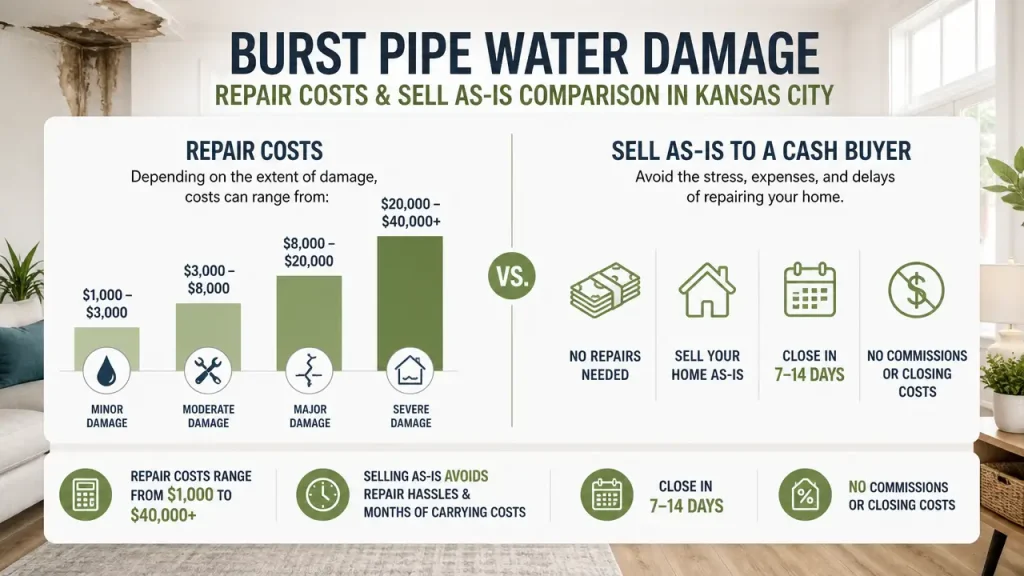
The plumber hands you a rough number and your stomach drops — maybe $8,000, maybe $25,000, maybe more. According to Angi’s Kansas City water damage data, restoration costs in KC typically run $600 to $1,900 for straightforward cleanups, but the real-world total climbs fast once drywall, flooring, and mold remediation enter the picture. The table below uses rough ranges — your actual bids will depend on scope, materials, and contractor availability.
| Damage Level | Typical Scope | Rough Cost Range (Estimate) |
| Minor | One room, surface water only, no drywall cut | $1,000 — $4,000 |
| Moderate | Multiple rooms, drywall demo up 2 ft, subfloor drying | $5,000 — $15,000 |
| Major | Full basement, multiple levels, structural checks, mold | $15,000 — $40,000+ |
Older Kansas City homes — think a Brookside stone basement or a Raytown split-level with galvanized supply lines behind a finished wall — often land in the moderate-to-major range because getting to the damaged pipe means tearing out more finish work. Add contractor backlog after regional deep freezes and costs can escalate further.
The highest repair estimate isn’t always the worst-case scenario — it’s the carrying costs underneath it that sink homeowners. Extra months of mortgage, utilities, and homeowners insurance while you live in a construction zone often add thousands more. A lower as-is cash offer today sometimes leaves more money in your pocket than the repair-and-list path when you do the full math.
If you want to see those numbers laid out plainly, Huck Buys Homes can walk you through a side-by-side comparison of what you’d net from a cash offer versus what you’d net after repairs and commissions on a traditional sale.
Two folders sit on the table — one with contractor estimates, one with a real estate agent’s list price projection — and you’re stuck between them. The real question isn’t which number is bigger on paper. It’s which path leaves you with more money, less stress, and a timeline that works for your life.
| Your Situation | Repair and Stay | Sell As-Is to Cash Buyer |
| Light damage, good insurance coverage | Usually the right call | May leave money on the table |
| Major mold or structural concern | Expensive, slow, uncertain | Straightforward exit, no contractor mgmt |
| Inherited or rental property, tenant gone | Unlikely to pencil out | Fast close, no rehab required |
| Pre-foreclosure or urgent timeline | Too slow — months of work | Close in 7-14 days, stop the clock |
| Claim denied or significantly underpaid | Out-of-pocket six figures | Damage priced into offer upfront |
A family in Olathe with a small laundry room burst and solid coverage should almost certainly repair and stay — the damage is contained, insurance covers most of it, and they plan to be there another decade. But a landlord in Kansas City, KS with a vacant duplex, a gutted basement, and a tenant who already left? Selling as-is to Huck Buys Homes often leaves more net cash and ends months of carrying costs immediately.
● Cash buyers expect damage: Huck Buys Homes looks at how much demo is needed, whether mechanical systems or the foundation are affected, and mold extent — they’re not surprised by any of it.
● No lender required: there’s no buyer’s underwriter to flag a half-torn-out basement or a room with missing drywall.
● No repair list: you don’t finish the repairs for the sale — the offer is made based on the condition it’s in right now.
● Flexible closing: close in as little as 7-14 days, or on a timeline that works for your situation.
If you’re in a situation involving foreclosure, probate, or divorce on top of water damage, the case for a clean, fast exit is even stronger. See how cash sales work for distressed Kansas City properties.
The remediation truck just pulled away and you’re staring at bare studs and fans humming in your basement. You’re not going through this again. Kansas City winters — with their freeze-thaw cycles and occasional deep-cold snaps — punish uninsulated pipes in basements, crawl spaces, and exterior walls every season.
A small investment in prevention pays off. According to the U.S. Department of Energy, insulating exposed pipes in basements and crawl spaces is one of the most effective ways to prevent freezing and bursts in cold climates.
● Insulate exposed pipes in unheated spaces: basements, crawl spaces, and exterior walls are the highest-risk zones in KC homes.
● Seal gaps where cold air reaches plumbing: check around dryer vents, foundation penetrations, and rim joists.
● Disconnect hoses and shut off exterior spigots before hard freezes: a connected garden hose holds water pressure against the shutoff and can force a burst.
● Keep heat at minimum 55 degrees when traveling: even a short weekend trip in January can be enough if the furnace cycles off.
● Open cabinet doors under sinks on exterior walls during cold snaps: it lets warm interior air reach the pipes.
● Check your sump pump annually: in low-lying KC areas, a burst pipe and a failed sump pump together can flood a basement in under an hour.
Huck Buys Homes sees preventable burst-pipe damage in older Kansas City homes all the time. They’re glad to offer an as-is way out when things go wrong — but they’re just as glad when neighbors catch it before a pipe lets go.
You’re standing in a half-demolished basement, fans humming, walls torn out, and you’ve been living with it for three weeks. The estimate keeps growing, the insurance adjuster is slow, and you’re starting to wonder if this house is worth the fight. That’s exactly where a local cash buyer fits.
Huck Buys Homes buys Kansas City area homes as-is on both the Missouri and Kansas sides — no lender involved, no appraisal, no underwriter flagging water stains or missing drywall. The burst pipe damage, the mold, the half-finished demo, the deferred repairs underneath all of it — that goes into the offer upfront, not surfaced three days before closing as a repair credit negotiation. Homeowners who come to Huck Buys Homes with a water-damaged property in Kansas City are typically dealing with more than one hard thing at once — an insurance dispute, a divorce, a probate situation, or a landlord relationship that already went sideways. Huck knows KC’s older housing stock, plumbing quirks, and basement layouts, so nothing in your situation is going to catch them off guard.
With 71 Google reviews and a 4.8-star rating, Huck Buys Homes has already helped dozens of Kansas City-area homeowners get a clean exit from exactly these situations — no commissions, no closing costs, closing in as little as 7 days.
Shut off the main water supply immediately, then cut power near any water-affected electrical. Document with photos and video before cleanup. Call your insurance claims line right away and get a claim number. Safety before anything else.
Most standard policies cover sudden, accidental burst pipes — but not long-term neglected leaks or river flooding. Report the loss quickly, follow mitigation instructions, and check whether sewer backup or sump pump failure require a separate endorsement.
Mitigation and drying typically take 3-7 days. Full reconstruction — drywall, flooring, paint — runs several weeks to months depending on scope and contractor availability. Post-freeze contractor backlogs in KC can stretch timelines considerably.
It depends on damage severity, insurance payout, and your timeline. Limited damage with strong coverage usually favors repair. Major mold, structural concerns, or a denied claim often make an as-is cash sale to Huck Buys Homes the smarter financial and emotional path.
Yes. Huck Buys Homes regularly buys Kansas City homes with water damage and mold. Remediation costs are priced into the offer — you don’t need to finish repairs, hire contractors, or clear out any damage before closing.
No. The only preparation that helps is basic safety steps — shut off the water, remove standing water if it’s safe. Gather your photos and any paperwork. No repairs, no cleanup projects, and no fixes are required before Huck Buys Homes makes an offer.
You’ve been through enough already — a burst pipe, insurance calls, restoration estimates, and the question of whether this house is worth fighting for. Here’s what you skip when you sell to Huck Buys Homes: no five-figure repair or mold-remediation project, no months living in a construction zone, no worrying whether a buyer’s lender will approve a home with recent water issues, no repair negotiations, and no commissions or closing costs to you.
Huck Buys Homes buys houses in Kansas City and the surrounding metro on both the Missouri and Kansas sides — as-is, in any condition, on a timeline that works for you. Reach out for a no-pressure cash offer on your Kansas City home today and find out what you’d actually walk away with.